
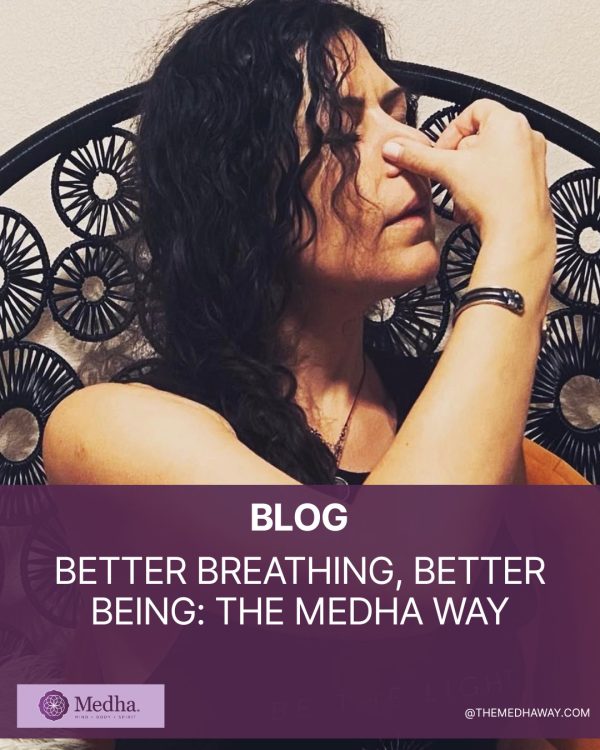
As someone who practices breathwork and meditation every day, I’ve come to see the breath as one of the most powerful tools we have for regulating our inner world. It is always with us—quietly moving in the background of our lives. Yet when we bring awareness to it, when we consciously shape and guide the breath, it becomes a direct pathway to calm, clarity, and resilience.
Over the years, I’ve leaned on my breath during some of life’s most difficult moments. I’ve used it lying on a surgical table before a cataract procedure, sitting in doctors’ offices awaiting difficult appointments, standing in a hospital room while my father was dying, and preparing for hard conversations when emotions ran high. In those moments, breath became an anchor. It steadied my body, softened my mind, and created just enough space to meet the moment with presence instead of panic.
The remarkable thing about breath is that it directly influences both our physical and emotional states. When we slow and regulate our breathing, we signal to the nervous system that it is safe to relax. The body responds quickly—muscles soften, heart rate steadies, and mental noise begins to settle. Over time, practicing intentional breathing doesn’t just help in moments of stress; it conditions the body and mind to return to balance more easily in everyday life.
The Medha Way: Small Moments, Big Impact
One of the core principles I teach through The Medha Way is that breathwork doesn’t need to be confined to a meditation cushion or a formal practice session. Instead, we can weave small moments of conscious breathing throughout the day—almost like drops of mindfulness placed into the natural pauses of life.
Think of the many small moments when we are already waiting or doing something routine: standing in line at the grocery store, waiting for a meeting to start, sitting at a red light, walking down a hallway, or washing dishes. Rather than filling those spaces with distraction, we can fill them with breath.
A few intentional breaths here and there—throughout the day—begin to train the nervous system to return to calm more easily. Over time, it becomes a habit. The breath becomes a quiet companion in daily life, always available to steady the body and clear the mind.
In this way, breathwork becomes less about adding another task to your wellness routine and more about infusing presence into the moments that already exist.


Four Simple Breath Practices
Here are four breathing techniques I often share with others. Each can be practiced for just a minute or two—and all of them fit beautifully into those small pauses during the day.
1. The 4-2-6 Breath (Deep Relaxation)
This technique is excellent for calming the nervous system when stress or anxiety arises.
How to practice:
- Inhale through the nose for 4 counts
- Hold gently for 2 counts
- Exhale slowly for 6 counts
Repeat for several cycles. The longer exhale signals the body to relax.
2. Box Breathing (Mental Focus)
Box breathing creates steadiness and clarity when the mind feels scattered.
How to practice:
- Inhale for 4 counts
- Hold for 4 counts
- Exhale for 4 counts
- Hold again for 4 counts
Visualize tracing the four sides of a square with your breath.
3. Alternate Nostril Breathing (Balancing Energy)
This traditional yogic practice helps calm the mind and balance the nervous system.
How to practice:
- Close the right nostril with your thumb and inhale through the left.
- Close the left nostril with your ring finger and exhale through the right.
- Inhale through the right, switch, and exhale through the left.
Continue for several rounds.
4. Ujjayi Breath (Ocean Breath)
Often used in yoga and meditation, ujjayi breathing deepens focus and lengthens the breath.
How to practice:
- Inhale slowly through the nose.
- Slightly constrict the back of the throat, as if gently fogging a mirror with your mouth closed.
- Exhale through the nose while maintaining that soft throat constriction.
The breath produces a quiet, ocean-like sound.
- Where am I resisting instead of responding?
- What would soften this moment?
- How can I move with what’s here instead of against it?
The breath produces a quiet, ocean-like sound.
The Takeaway
People often fall in love with breathwork because the effects are both immediate and profound. Conscious breathing calms stress and anxiety by activating the body’s relaxation response. It improves focus when the mind feels scattered and helps balance our energy and mood.
And when practiced The Medha Way—bit by bit throughout the day—it becomes something even more powerful: a habit of returning home to yourself.
Before a meeting.
After a long stretch of screen time.
While waiting for your coffee.
Lying in bed when your mind won’t slow down.
The breath reminds us that calm is never far away.
Sometimes it is simply one conscious inhale…
and one soft exhale… away.
Latest Posts
Be Water: How Bruce Lee’s Philosophy Taught Me to Stop Resisting Life
When we think about heart health, we usually picture treadmills and salads. But chronic stress is the invisible workout your heart never signed up for. Discover how meditation creates measurable physiological changes—from lowering blood pressure to boosting HRV—to help your system finally find its way back to balance.
The Enduring Anchor: Lessons in Resilience from Ruth Bader Ginsburg
When we think about heart health, we usually picture treadmills and salads. But chronic stress is the invisible workout your heart never signed up for. Discover how meditation creates measurable physiological changes—from lowering blood pressure to boosting HRV—to help your system finally find its way back to balance.