
For me, meditation is the bedrock of personal transformation because it cultivates self-awareness or knowing oneself more clearly.
Most of us move through a surprising amount of life on autopilot. Reacting from habits, emotions, and patterns we may not even recognize. Meditation trains us to observe what is happening within us without immediately reacting to it.
I began my daily meditation practice in 2014 after finding myself in a state of complete burnout, desperate for change and a way to simply feel a little better. Twelve years later, I have seen such meaningful effects play out repeatedly in both my personal and professional life that I am inspired to teach and help others to achieve the same.
Having cultivated a certain level of awareness, I believe it is a kind of superpower, almost like a Spidey sense. And when we turn the awareness inward, it becomes self-awareness, and that is where the magic is.
I felt this firsthand when an employee of mine was explaining a costly mistake she had made. As she was telling me what happened, I felt my heartbeat and breathing speed up, my mind began to race and then, I caught myself. I was aware of what was happening in my mind and body, and I knew that focusing on my breathing would calm everything down. So that is what I did. I focused on taking deep conscious breaths as I listened and, in that moment, I shifted out of panic and blame and into problem-solving mode. That brief pause changed the entire trajectory of that situation for the better and I have experienced this time and again.
Awareness Before Transformation
Meaningful change begins with seeing our patterns clearly. Awareness, which we develop through meditation, helps us recognize what is supporting us, what may be holding us back, and where a different choice could lead to a better outcome.
Over the years, greater self-awareness and emotional regulation have helped me quit smoking cigarettes, stop drinking alcohol, navigate a cancer diagnosis and recovery, establish a much steadier approach to self-care, maneuver relationships better, and get promoted twice.
Meditation has helped me cultivate the awareness that makes that kind of transformation possible. When we learn to pause and observe ourselves more clearly, we create space between habit and choice, and that is often where meaningful change begins.
When we make conscious choices repeatedly, at work, at home, in our relationships, and in the way we care for ourselves, something larger begins to happen.
We change.
That is why I believe self-awareness is one of the most powerful tools we have for meaningful personal transformation. And meditation is one of the simplest ways I know to practice it.

Meditation as Mental Training
At its core, meditation is a practical form of mental training. Think of it like exercise for the brain. In weight training, repeatedly lifting the weight is what builds and strengthens the muscle. In meditation, repetition strengthens our ability to hold our attention, become more aware of our thoughts and reactions, and ultimately make more conscious choices.
Much like physical training, there are many different types of meditation. One of the most beautiful things about meditation is that there are no prerequisites, and it does not require adopting or changing any religious or spiritual beliefs. It can simply be approached as a secular practice for training attention and awareness.
What Science Says
The benefits of meditation are not just subjective. There is a growing body of scientific research suggesting that a regular meditation practice can support both our mental and physical well-being. The Mayo Clinic, for example, identifies greater self-awareness as one of the potential benefits of meditation, along with improved stress management, present-moment focus, patience, and sleep.
Learn more about the benefits of meditation from the Mayo Clinic.
Perhaps the most fascinating thing to me is what researchers are learning about neuroplasticity and the brain’s ability to change and adapt throughout our lives. Brain-imaging research suggests that meditation can influence the activity, connectivity, and even structure of regions involved in attention, self-awareness, stress response, and emotional regulation.
In other words, research suggests that consistent meditation practice may help train the brain, and our nervous system, to respond differently to our experiences. Meditation does not make life’s stressors disappear, but it may help change the way our minds and bodies meet them.
Basics of Meditation
At its most basic, meditation is a simple practice of training your attention. It usually involves sitting comfortably, although some practices can be done lying down, and choosing something to serve as an anchor for your attention.
That anchor might be your breath, a word or phrase repeated silently, a visualization, or even a physical object. The technique itself is straightforward: focus your attention on the anchor. When you notice that your mind has wandered, which it inevitably will, simply bring your attention back. Then repeat.
Focus. Notice. Return. Repeat.
That repetition is an important part of the practice. The goal is not to stop thinking, empty your mind, or achieve some particular state. It is to become better at noticing where your attention has gone and intentionally directing it back.
Some days this will feel relatively easy. Other days your mind may seem to wander constantly. Both are part of the training. Much like physical exercise, every repetition counts. Each time you notice your attention has wandered and bring it back, you are practicing the fundamental skills of attention and awareness. Skills that can carry over into how you focus, respond, and make decisions throughout the rest of your day.
Different Ways to Meditate
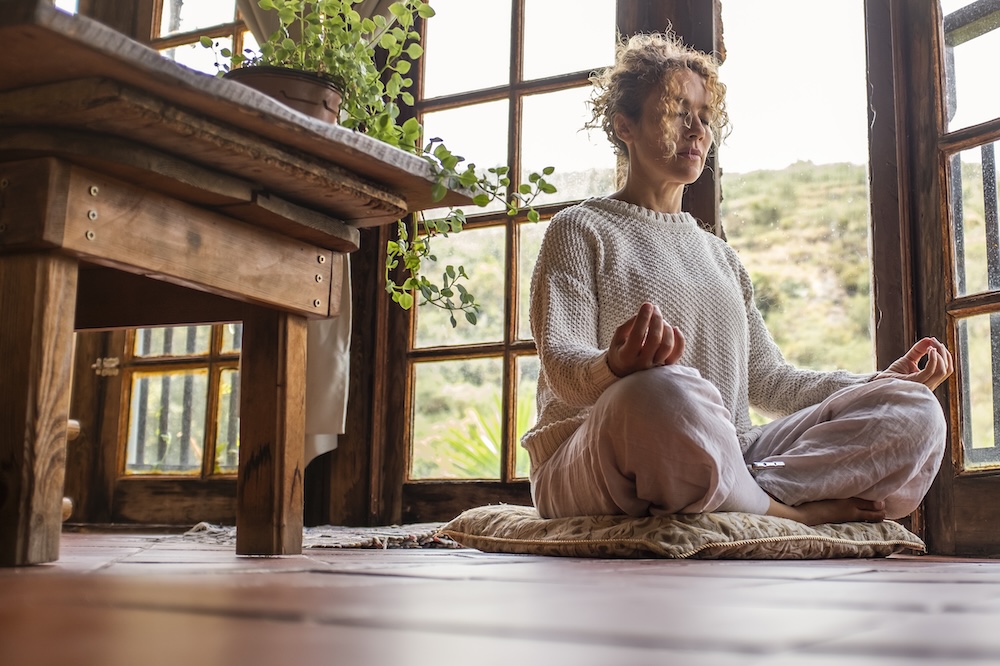
There is no single “right” way to meditate. There are many approaches, and finding one that works for you matters more than mastering a particular technique.
Some of the most common include breath meditation, using the breath as an anchor; mindfulness, observing your present experience with less judgment; guided meditation and visualization, following spoken instruction; movement meditation, bringing awareness to activities like walking or yoga; and mantra meditation, silently repeating a word, phrase, or sound.
Other practices may use sound, reflection, loving-kindness, or prayer as a focus. My own practice is rooted primarily in mantra meditation, which had such a meaningful impact on me that I eventually became certified to teach Primordial Sound Meditation.
The methods may look different, but they share a common thread: direct your attention, notice when the mind wanders, and return. The best place to begin is simply with the practice that feels most comfortable to you.
How Do I Start?
Most importantly, remember that meditation can be practiced almost anywhere. You do not need the perfect setting, the perfect technique, or a perfectly quiet mind.
Start with 5–10 minutes. Choose a practice that feels approachable. And then give yourself the opportunity to experience what happens when you return to it consistently.
If you set a timer, try to stay with the practice until it ends, even on the restless days. If ten minutes feels like too much, try five the next day. The goal is not perfection. The goal is practice.
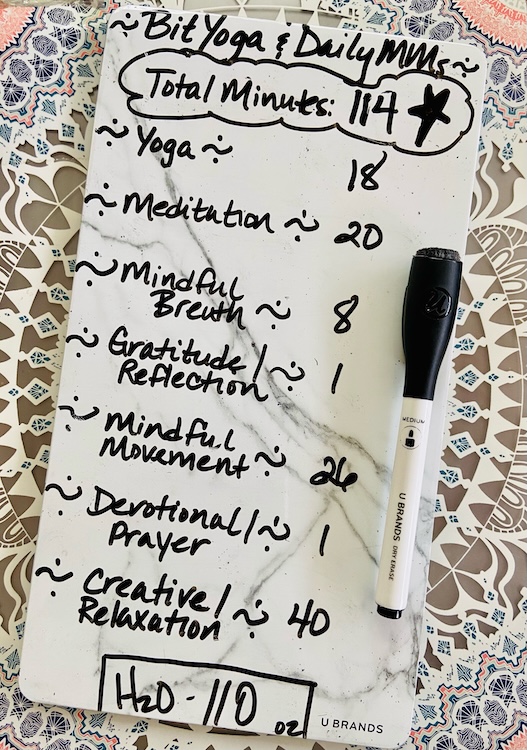
And if you’re like me and enjoy seeing your consistency build over time, use the Medha Daily Self-Care Tracker to record your practice. Sometimes simply seeing those few minutes accumulate is enough encouragement to keep going.
Because meaningful change rarely happens all at once. It begins by becoming a little more aware of ourselves—our thoughts, our reactions, our patterns, and our choices.
A few minutes of meditation each day can be a simple place to begin.
Frequently Asked Questions
Do I need to clear my mind completely to meditate successfully?
No. The goal of meditation is not to stop your thoughts or empty your mind. Meditation is simply a practice of training your attention. Every time your mind wanders and you notice it, gently bringing your focus back to your anchor (such as your breath or a mantra) is where the mental training actually happens.
How does meditation support neuroplasticity and brain health?
Brain-imaging research suggests that consistent meditation can influence the activity and structure of regions in the brain involved in self-awareness, attention, emotional regulation, and stress response. Through neuroplasticity—the brain’s ability to adapt and change—meditation helps train your nervous system to respond differently to daily stressors.
How long should I meditate each day when starting out?
Consistency matters far more than duration. Starting with just 5 to 10 minutes a day is an approachable, realistic way to build a sustainable practice. Even a few quiet minutes each morning allows you to accumulate consistency over time and begin noticing shifts in your daily self-awareness.